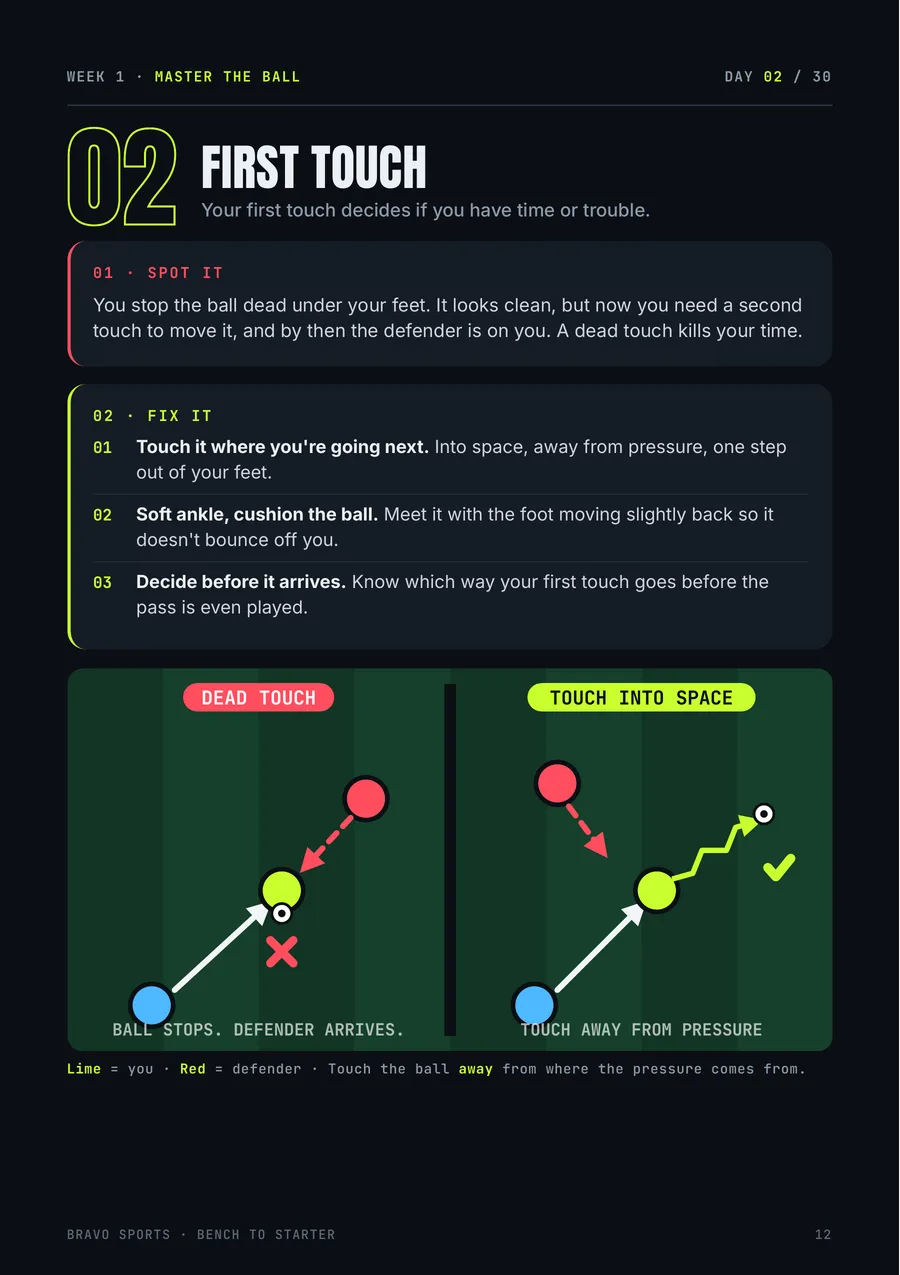
Your first touch dies under your feet
You stop it dead, need a second touch to move it, and the defender is already on you.
Touch the ball away from where the pressure comes from.
Vol. 01 · Football
The 30-Day Football Upgrade
30 days. 30 fixes. 20 minutes a day.
The habits coaches notice in the first five minutes of a game, trained one day at a time with a ball, a wall and a few cones.
Six habits that keep good players on the bench. Each one gets its own day in the plan.
You stop it dead, need a second touch to move it, and the defender is already on you.
Touch the ball away from where the pressure comes from.
Defenders show you onto it because they know you won't use it. Switching feet costs you a second every time.
By then the moment's gone. You never saw the defender behind you or the run in front of you.
It flies over, or straight at the keeper. Power without direction is a gift to the goalkeeper.
The attacker knocks it past you and you're out of the game. Most 1v1s are lost by the defender.
Late in games you're a step behind everything. Long slow jogs won't fix it. Repeat sprints will.
Every day follows the same format, so you never waste time working out what to do. Left page: the problem and the fix. Right page: the drill and the test.
The mistake most players make, and why it costs them.
Three coaching keys and a diagram that shows the right way.
One drill with setup, reps and time. Plus a level-up when it gets easy.
Tick the boxes. Can't tick them? Repeat the day tomorrow.
About 10 × 10 metres: a garden, a car park or the side of a pitch.
Week 1 builds your touch. Week 2 builds your brain. Week 3 makes you dangerous at both ends. Week 4 gets you fit, strong and ready on matchday.
By the end: Clean first touch, a usable weak foot, and passes that land on the right foot.
Baseline testTest
You can't improve what you don't measure.
First touch
Your first touch decides if you have time or trouble.
The weak foot
Defenders read one-footed players like a book.
Ball mastery
The ball should feel like part of your foot.
Passing technique
A bad pass makes your teammate look bad too.
Open body shape
Receive half-turned and you can see the whole pitch.
Review + juggling ladder
Lock in week 1 before you build on it.
By the end: Scan before every receive, get open on purpose, and choose the right pass.
Scanning
Look before you get it, not after.
Find the pocket
If the passer can't see you, you're not open.
Check away, come short
Move the defender before you move yourself.
Pass and move
Your job isn't done when the ball leaves your foot.
Make the right choice
The best players aren't faster. They decide faster.
The 5-second switch
Games are won in the moments after the ball changes hands.
Talk + week 2 review
The quietest team on the pitch is the easiest to beat.
By the end: Win more 1v1s at both ends and put more shots on target.
Change of pace
Speed doesn't beat defenders. Change of speed does.
Beat your man
Make the defender commit. Then go where they're not.
Finish your chances
Placement beats power. Every time.
Strike it clean
Good technique makes the ball fly low and hard.
The final ball
Get to the byline. Then pull it back.
Defend 1v1
Patience wins the ball. Diving in gives it away.
Press with your brain
Don't just run at the ball. Run so they can't pass.
By the end: Quicker first steps, last the full game, and show up ready on matchday.
Explosive first steps
Win the first five metres.
Stop, turn, go
Agility is how fast you stop and change.
Last the 90
Football fitness is sprint, recover, sprint again.
Bulletproof body
The best ability is availability.
Recover like a pro
You get better after training, not during it.
Bounce back
Good players recover from a mistake in three seconds.
Matchday routine
Don't hope you feel ready. Follow a plan.
Put it all together
One session. Everything you've built.
RetestTest
Same tests. Same rules. Different player.
Real pages from the book. Every training day is a two-page spread: the problem and the fix, then the drill and the test.
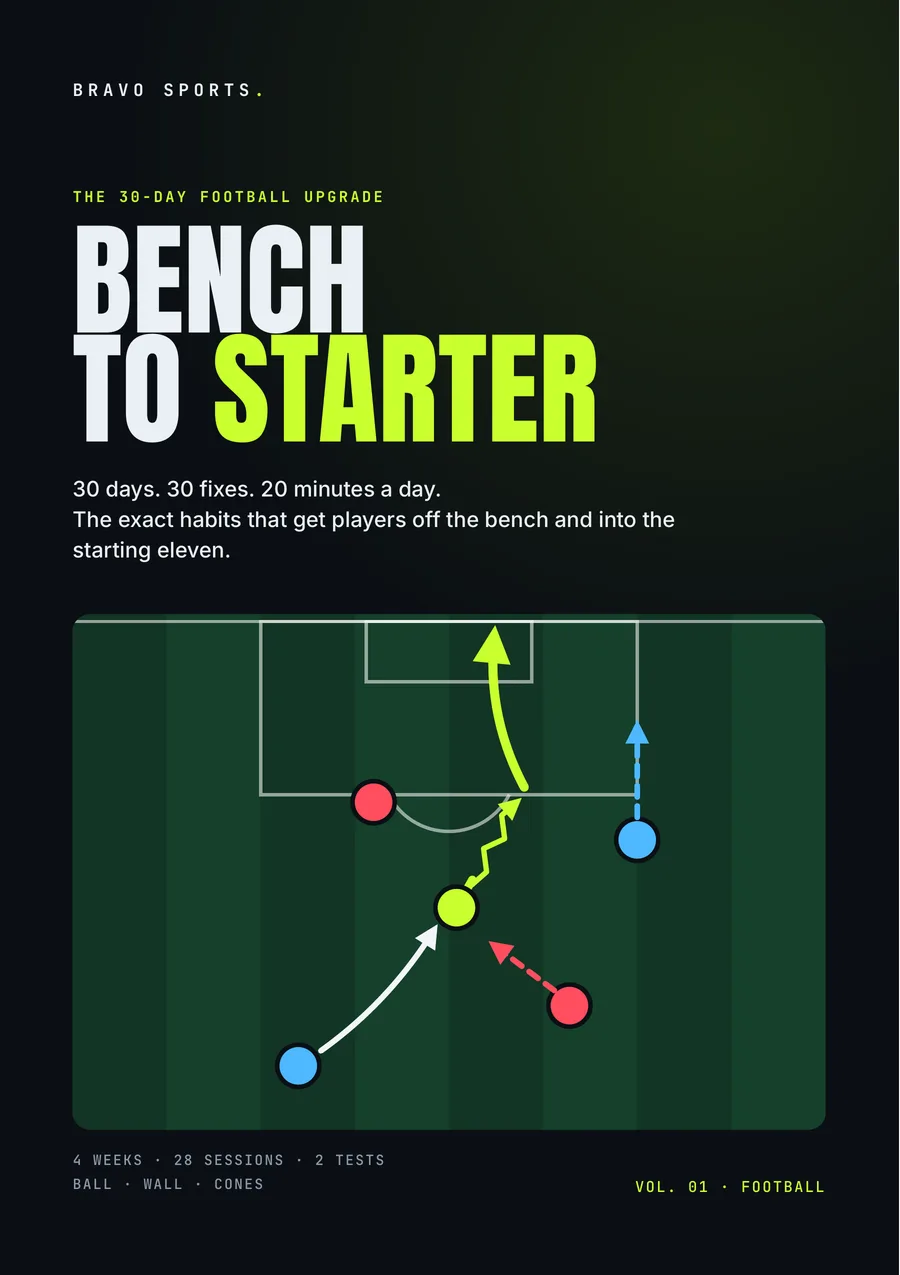
Page 01 of 78
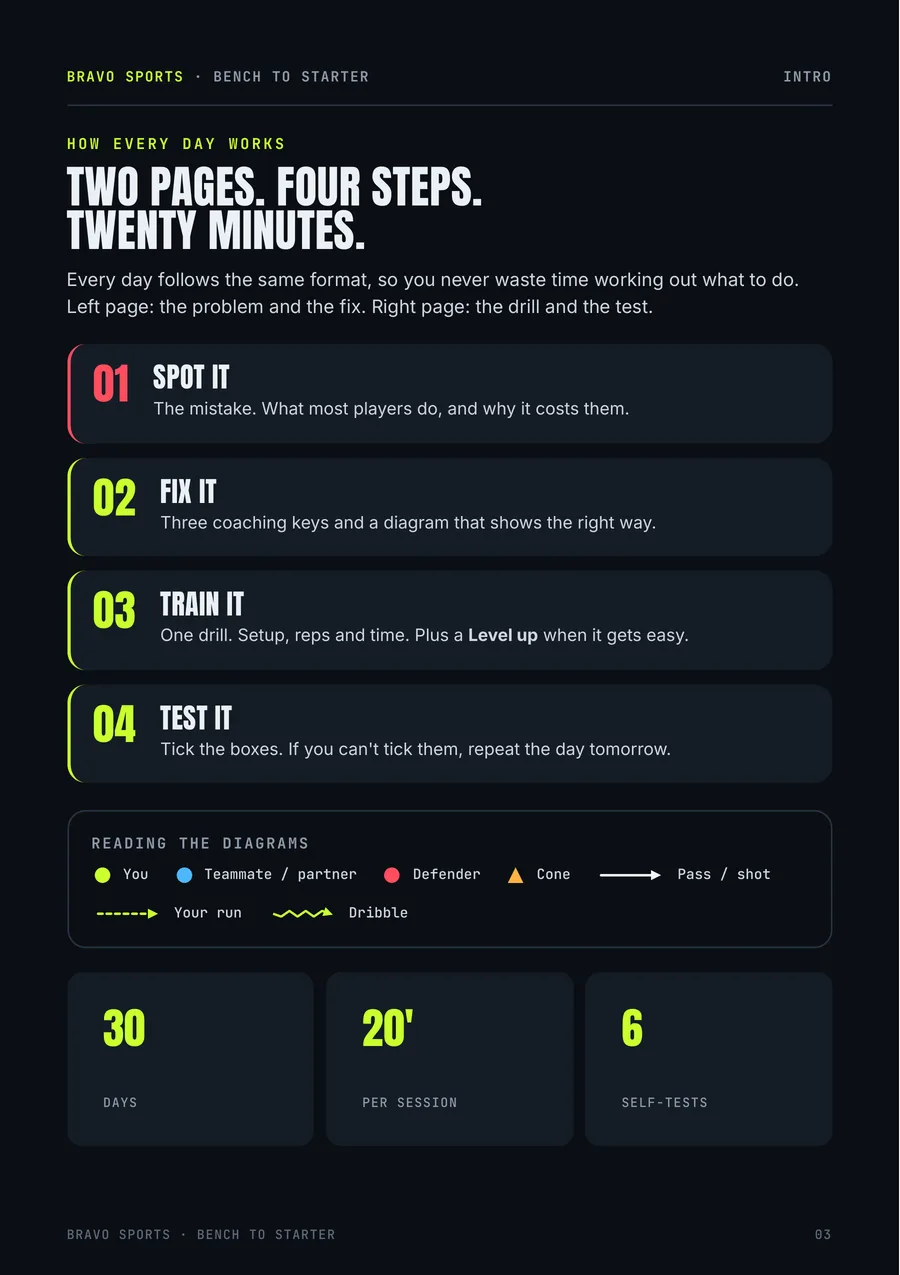
Page 03 of 78
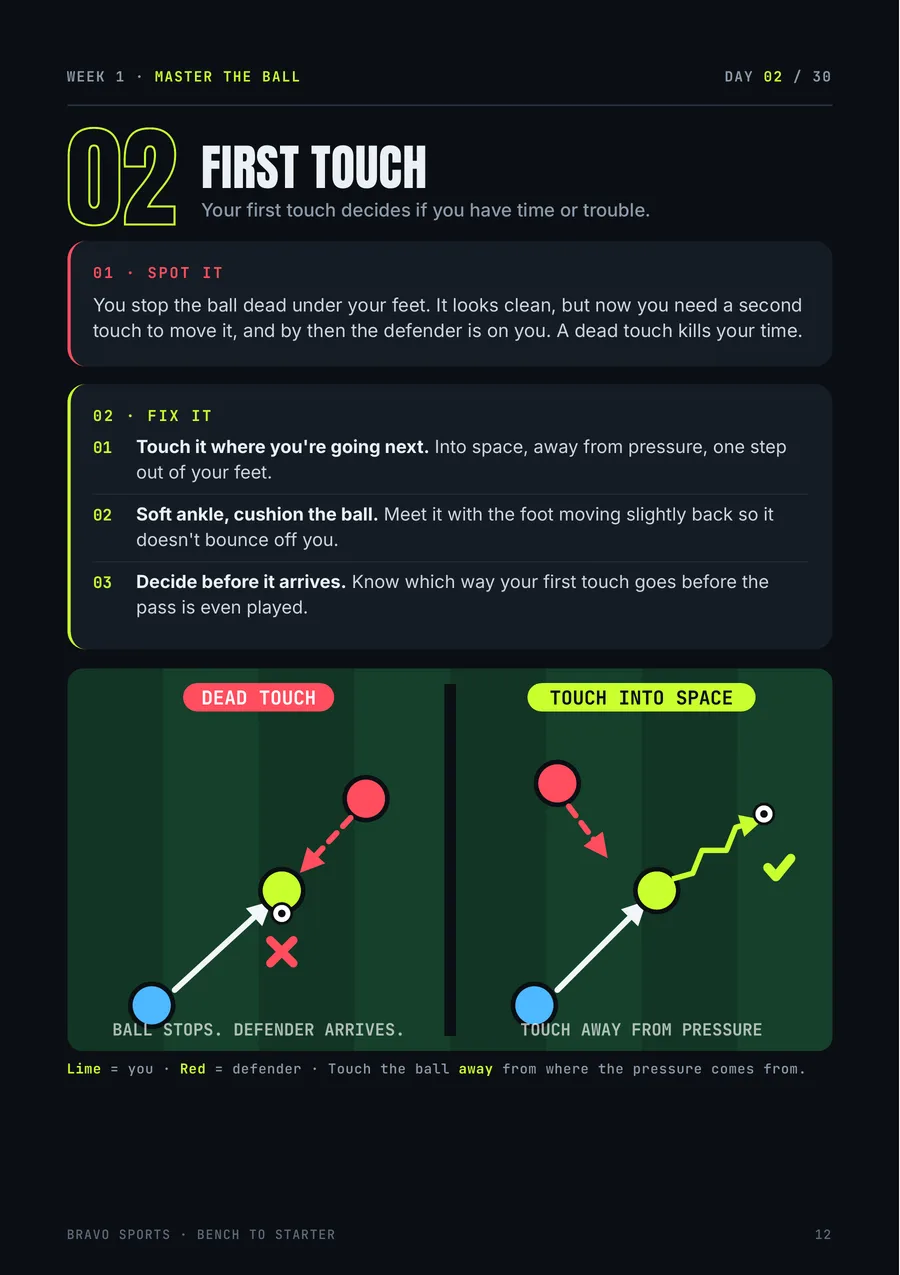
Page 12 of 78
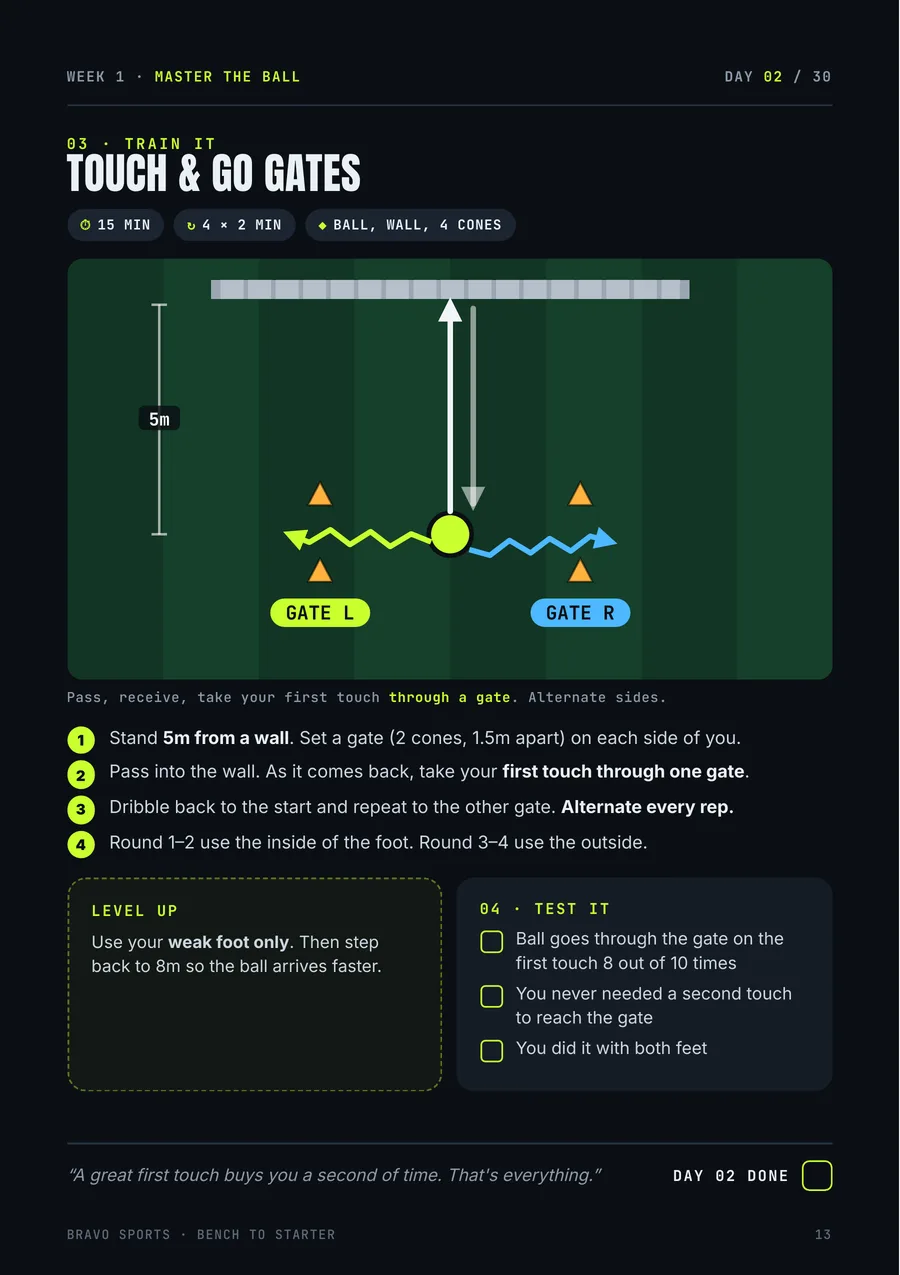
Page 13 of 78
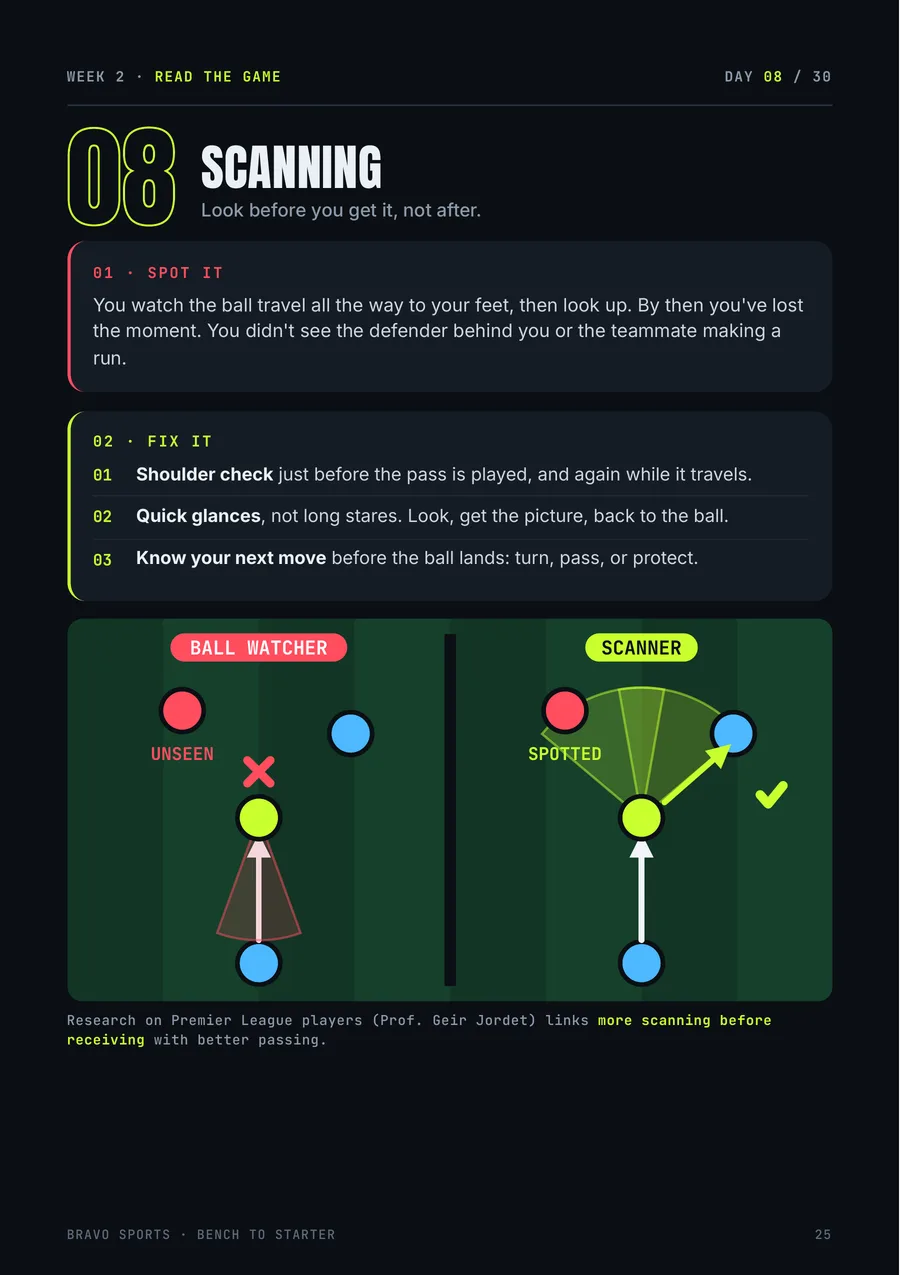
Page 25 of 78
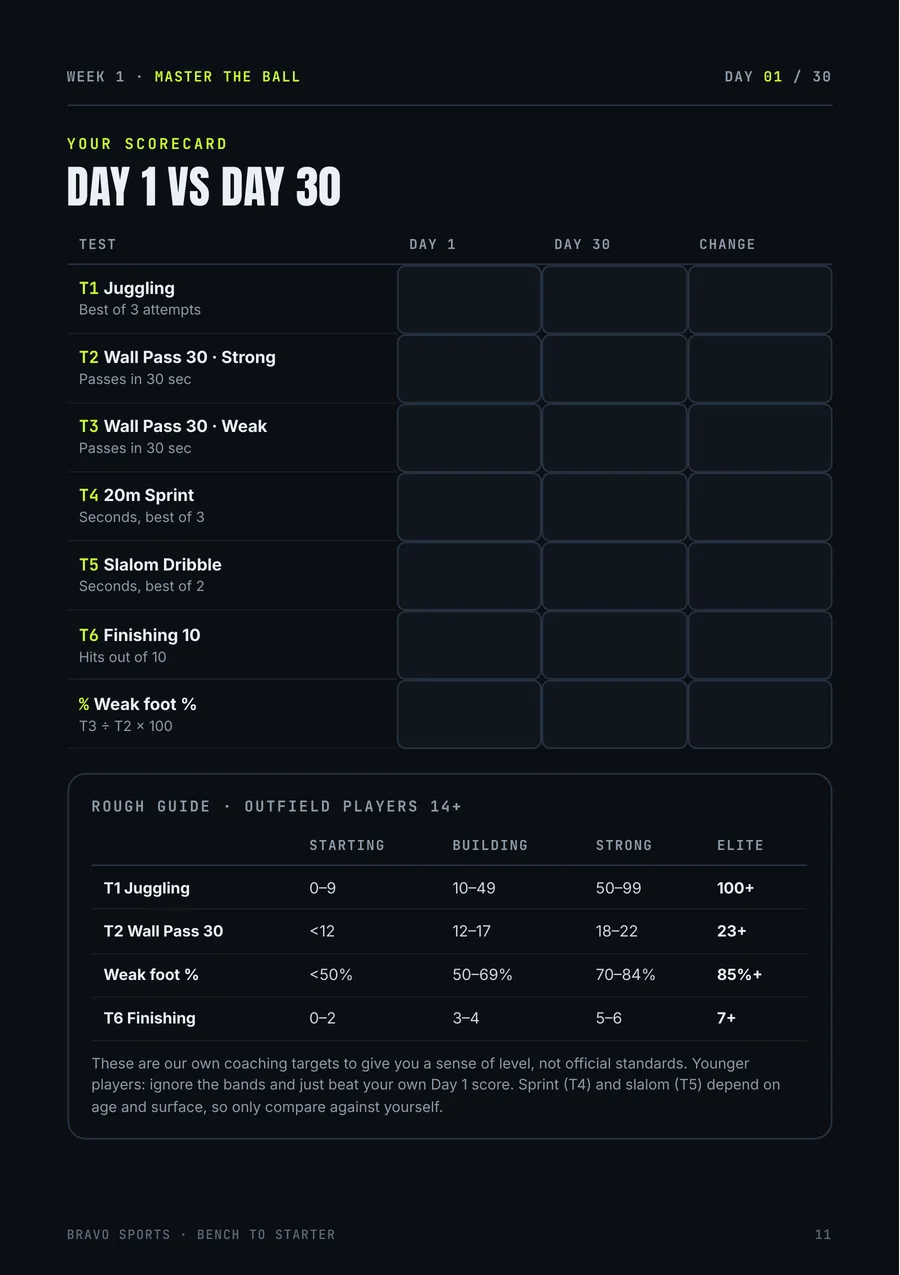
Page 11 of 78
Six tests measure your touch, both feet, speed, close control and finishing. Same tests, same rules, so the difference is there in black and white.
Rough guide for outfield players aged 14+.
| Test | Starting | Building | Strong | Elite |
|---|---|---|---|---|
| T1 Juggling | 0–9 | 10–49 | 50–99 | 100+ |
| T2 Wall pass 30 | <12 | 12–17 | 18–22 | 23+ |
| Weak foot % | <50% | 50–69% | 70–84% | 85%+ |
| T6 Finishing | 0–2 | 3–4 | 5–6 | 7+ |
These are our own coaching targets, not official standards. Younger players: ignore the bands and beat your own Day 1 score.
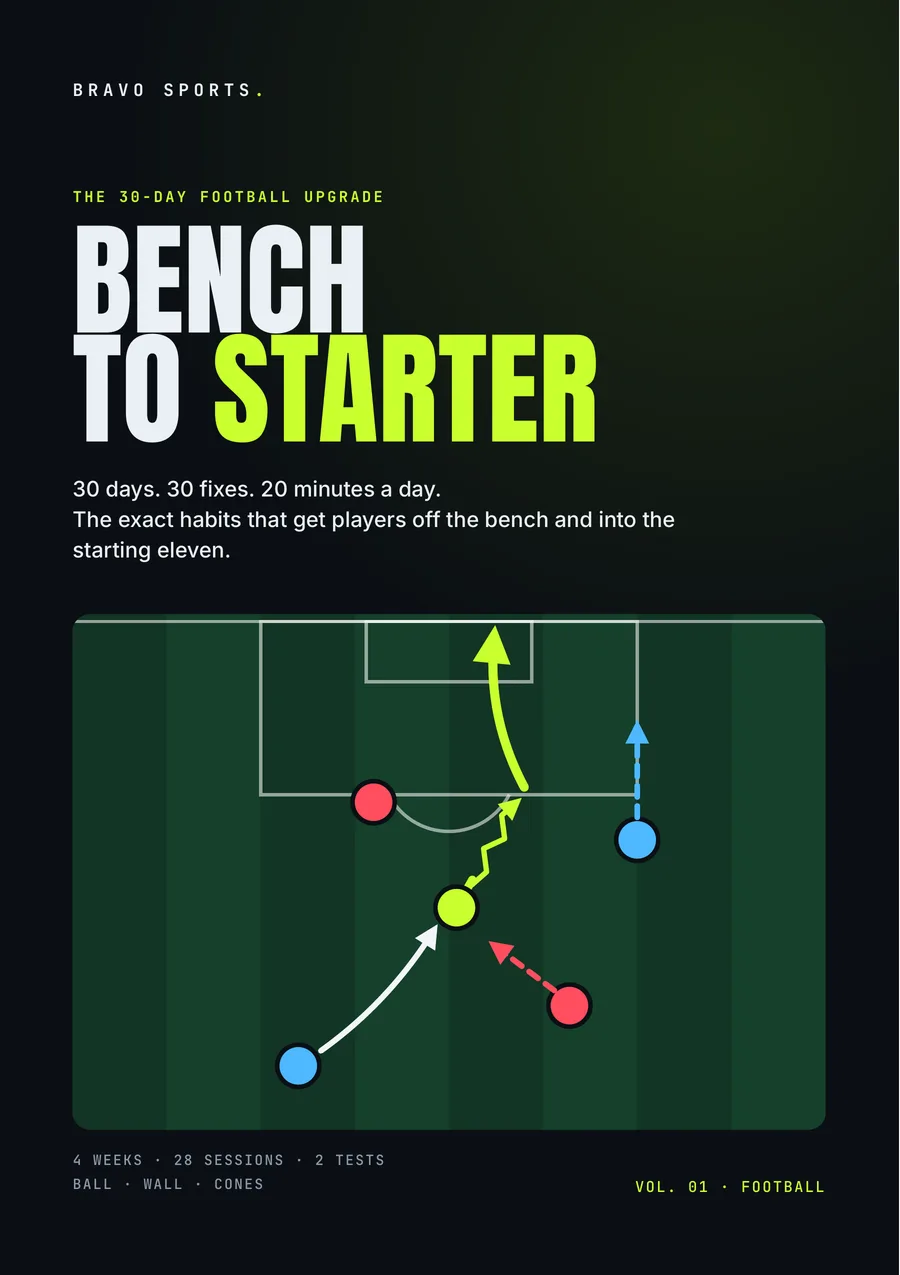
Vol. 01 · football
The 30-Day Football Upgrade
$19.99one-time payment
A 78-page PDF: 28 training days, a baseline test on Day 1 and a retest on Day 30, a diagram for every drill, a scorecard and a 30-day tracker.
Straight away. Your download link shows on the confirmation page and we email it to you too. The link works for 7 days, so save the PDF to your phone or computer. Your receipt comes separately from Lemon Squeezy, our payment provider.
No. You pay once and the PDF is yours.
A ball (size 4 or 5), a wall or rebounder, about 6 cones (bottles work) and your phone for a timer. Around 10 × 10 metres of space: a garden, a car park or the side of a pitch.
About 20 minutes after the 6-minute warm-up. Review days and the full session on Day 29 run 30–45 minutes.
No. Every day works on your own with a wall. Some days are better with a friend, and the book says when.
Pick up where you left off. 30 sessions matters more than 30 days in a row. Aim for 5–6 sessions a week with at least one rest day.
Yes, it's built for players 12 and up. Let a parent or guardian know what you're doing. It's general training guidance, not medical advice, so check with a doctor first if you're injured or have a health condition.
It's an instant digital download, so all sales are final. If your file won't open or you were charged twice, email us and we'll fix it.